Business

Passive Income 2026 Modern Wealth Building Strategies
The global business landscape in 2026 has transitioned into a “Systems-First” era, where the traditional link between manual labor and
The global business landscape in 2026 has transitioned into a “Systems-First” era, where the traditional link between manual labor and
Starting a new venture today feels more accessible than ever before. You no longer need a massive office or a
Starting new venture feels exciting. Many people seek ways earning online income daily. You can build successful startups using digital
The global business landscape in 2026 has transitioned into a “Systems-First” era, where the traditional link between manual labor and revenue has been permanently severed. We are witnessing a massive migration from centralized corporate structures toward decentralized Scalable Business Models driven by individual operators. This shift is fueled by the maturity of autonomous workflows, where the primary role of the entrepreneur has moved from “worker” to “engineer.” In this environment, Passive Income Ideas 2026 are no longer about speculative trends but about owning high-utility digital infrastructure. The rise of the “solopreneur” economy means that a single person can now manage complex operations that previously required entire departments. Success in 2026 is defined by how well an individual can leverage these automated systems to solve real-world problems. By focusing on digital assets that provide recurring value, entrepreneurs are building recession-proof wealth that scales without a proportional increase in effort or overhead.
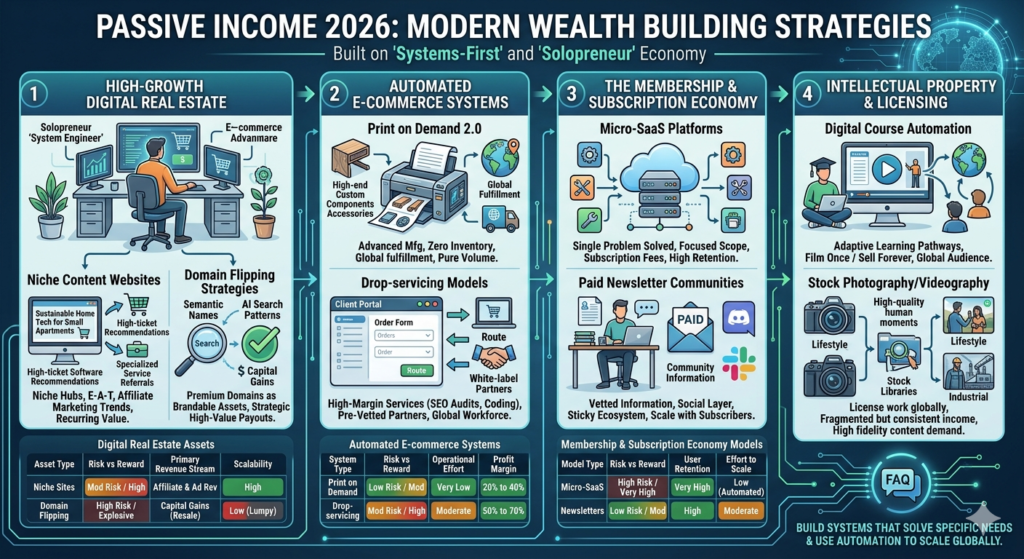
Digital real estate in 2026 is the most stable foundation for long-term wealth. Unlike physical property, these assets have zero maintenance costs and infinite global reach. This sector focuses on capturing attention and converting it into measurable data or leads, which brands are willing to pay for at a premium.
Niche websites have evolved into hyper-specialized utility hubs. In 2026, general blogs are ignored by search engines in favor of sites that offer “Expertise, Authoritativeness, and Trust” (E-A-T) in a narrow vertical. These sites serve as the primary engine for Affiliate Marketing Trends, where income is generated through high-ticket software recommendations or specialized service referrals. By dominating a specific topic—such as “Sustainable Home Tech for Small Apartments”—the owner creates a “moat” that is difficult for competitors to cross.
The market for premium domains has surged as brand identity becomes the most valuable currency online. Strategic domain flipping now involves securing “semantic” names that align with AI search patterns. Investors are no longer just buying random words; they are acquiring brandable assets that define entire industries. In 2026, the strategy is to hold these assets for high-value acquisitions by startups looking for instant market authority. The payout for a single well-placed domain can often equal years of traditional salary.
| Asset Type | Risk vs Reward | Primary Revenue Stream | Scalability |
|---|---|---|---|
| Niche Sites | Moderate Risk / High Reward | Affiliate & Ad Revenue | High |
| Domain Flipping | High Risk / Explosive Reward | Capital Gains (Resale) | Low (Lumpy) |
E-commerce in 2026 is no longer about managing warehouses or shipping boxes. The industry has fully shifted toward “zero-inventory” models that prioritize design and service over logistics. Automation handles the entire lifecycle of a transaction, from the initial click to final delivery, allowing the business owner to remain entirely hands-off.
The 2.0 version of Print on Demand leverages advanced manufacturing that allows for high-end, custom-made goods beyond simple apparel. From specialized furniture components to customized tech accessories, POD 2.0 uses global fulfillment networks that ship within hours. The owner’s only job is to provide the creative “IP” (Intellectual Property). This is a pure volume game; once a design goes viral, the system handles 10,000 orders as easily as it handles one, making it a cornerstone of Passive Income Ideas 2026.
Drop-servicing is the high-margin sibling of dropshipping. Instead of physical goods, you sell high-demand digital services like advanced SEO audits or specialized coding. The automation comes through a “Client Portal” system where orders are automatically routed to pre-vetted white-label partners. The owner acts as the brand manager and strategist, while the actual technical work is fulfilled by a global workforce. This model allows for massive scaling without ever needing to hire a full-time employee, turning high-value skills into a repeatable, automated system.
| System Type | Risk vs Reward | Operational Effort | Profit Margin |
|---|---|---|---|
| Print on Demand | Low Risk / Moderate Reward | Very Low | 20% to 40% |
| Drop-servicing | Moderate Risk / High Reward | Moderate | 50% to 70% |
The most valuable businesses in 2026 are those that generate monthly recurring revenue (MRR). The shift from one-time sales to the Membership Economy provides the financial predictability needed for true freedom. This model builds a community around a product or service, ensuring that once a customer is acquired, they provide value for years.
Micro-SaaS involves building a small, focused software solution that solves a single problem for a specific user base. These are typically plugins, extensions, or API-based tools. In 2026, these platforms are highly sought after because they integrate directly into existing workflows. Because the scope is narrow, the maintenance is minimal. Once the software is built and the bugs are squashed, the subscription fees provide a steady, automated income stream that requires very little active management.
Curation is the new gold. As the internet becomes flooded with AI-generated noise, people are paying for vetted, high-quality information delivered to their inbox. Paid newsletters in 2026 often include access to private Discord or Slack communities, adding a social layer to the information. This creates a “sticky” ecosystem where members stay for the networking as much as the content. For the owner, the work is limited to a few hours of research a week, while the revenue scales exponentially with the subscriber count.
| Model Type | Risk vs Reward | User Retention | Effort to Scale |
|---|---|---|---|
| Micro-SaaS | High Risk / Very High Reward | Very High | Low (Automated) |
| Newsletters | Low Risk / Moderate Reward | High | Moderate |
Intellectual property is the ultimate “build once, sell forever” asset class. In 2026, IP is treated like a financial security that can be leveraged and licensed globally. This allows creators to monetize their expertise or creative output across multiple platforms simultaneously without any additional labor.
The e-learning market has moved away from live teaching toward fully automated “Learning Pathways.” These systems use adaptive technology to guide students through a curriculum based on their progress. For the creator, this means a course filmed in 2025 can continue to generate revenue in 2026 and beyond. By using automated marketing funnels, the course sells itself to a global audience 24 hours a day.
The demand for high-fidelity, authentic visual content is insatiable. By contributing to global stock libraries, you license your work to millions of businesses. Each download earns a royalty, creating a fragmented but consistent income stream. In 2026, the focus is on “lifestyle” and “industrial” footage that AI still struggles to replicate with total accuracy, ensuring a steady demand for human-captured media.
As we have explored, Passive Income Ideas 2026 are centered on the transition from active labor to asset ownership. By implementing Scalable Business Models like Micro-SaaS, Digital Real Estate, or Automated E-commerce, you are building a financial engine that operates independently of your time. The key is to start by building a system that solves a specific market need and then using automation to scale that solution globally.
Focus on the intersection of what you know and what can be automated. If you have technical skills, Micro-SaaS is ideal. If you have marketing skills, Drop-servicing or Niche Sites provide the best return on time.
The fastest path is often through Print on Demand or Paid Newsletters, as these require the least amount of technical setup and can be launched within days.
Digital Real Estate has a much lower entry cost and higher potential for rapid appreciation. While physical property yields 5% to 10% annually, a successful niche site can yield 100% or more.
Yes. Because these models rely on automated systems, they are specifically designed to be managed in just a few hours per week once the initial setup is complete.
The trend is moving toward “recurring high-ticket” affiliate offers. Instead of small retail commissions, focus on B2B software where you earn a percentage of the monthly subscription fee for the life of the customer.