Introduction
Decentralized Finance, commonly known as DeFi, has become one of the most transformative sectors within the cryptocurrency industry. In 2026, DeFi is no longer experimental technology — it is a rapidly expanding alternative financial system built on blockchain networks.
Unlike traditional finance, DeFi removes intermediaries such as banks and brokers, allowing users to transact directly through smart contracts.
What Is DeFi?
DeFi refers to financial applications built on blockchain technology that operate without centralized control. Most DeFi platforms run on Ethereum, although other networks like Solana and BNB Chain are also widely used.
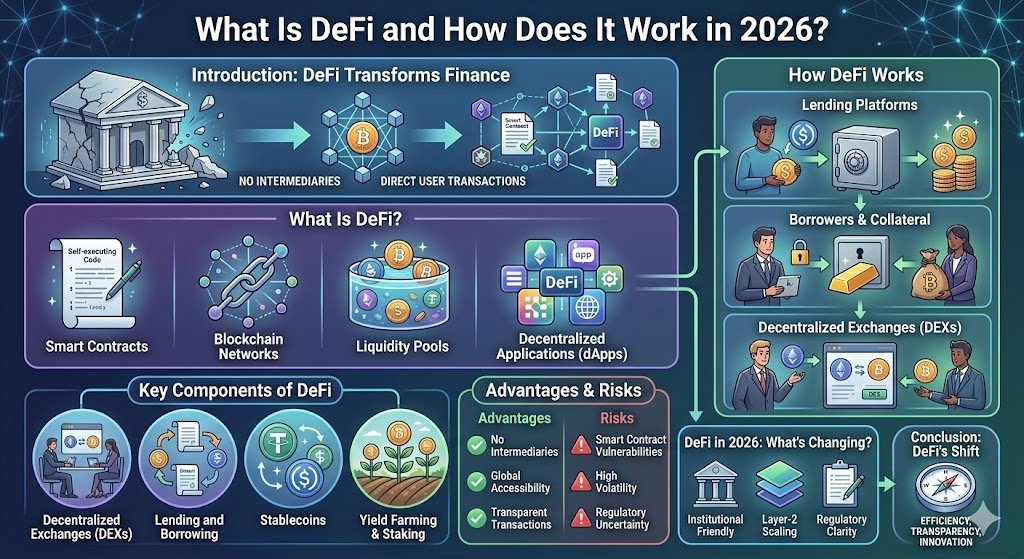
Instead of relying on banks, DeFi uses:
- Smart contracts
- Blockchain networks
- Liquidity pools
- Decentralized applications (dApps)
These systems operate transparently and automatically.
How DeFi Works
DeFi platforms use smart contracts — self-executing programs stored on a blockchain. Once conditions are met, the contract executes automatically.
For example:
- Lending platforms allow users to deposit crypto and earn interest.
- Borrowers can take loans by providing collateral.
- Decentralized exchanges enable peer-to-peer trading without intermediaries.
All transactions are recorded on-chain, increasing transparency.
Key Components of DeFi
1. Decentralized Exchanges (DEXs)
DEXs allow users to trade cryptocurrencies without centralized exchanges. Trades are executed via liquidity pools instead of traditional order books.
2. Lending and Borrowing Platforms
Users can earn yield by lending assets or borrow funds by locking collateral into smart contracts.
3. Stablecoins
Stablecoins reduce volatility and are widely used within DeFi ecosystems for payments and lending activities.
4. Yield Farming and Staking
Users can lock tokens in DeFi protocols to earn rewards, creating passive income opportunities.
Advantages of DeFi
- No intermediaries
- Global accessibility
- Transparent transactions
- Programmable financial services
- Higher yield potential compared to traditional banking
Risks of DeFi
- Smart contract vulnerabilities
- High market volatility
- Impermanent loss in liquidity pools
- Regulatory uncertainty
- Platform security risks
Investors should conduct thorough research and apply risk management strategies before participating in DeFi platforms.
DeFi in 2026: What’s Changing?
In 2026, DeFi is becoming more institutional-friendly due to improved smart contract auditing, cross-chain interoperability, Layer-2 scaling solutions, and increasing regulatory clarity in certain regions.
Traditional financial institutions are also exploring hybrid models that integrate decentralized finance principles.
Conclusion
DeFi represents a fundamental shift in how financial services operate. By eliminating intermediaries and leveraging blockchain technology, decentralized finance offers efficiency, transparency, and innovation.
However, it remains a high-risk, high-reward sector that requires careful planning, research, and disciplined investment strategies.
Frequently Asked Questions (FAQs)
1. What is DeFi in simple terms?
DeFi, or Decentralized Finance, is a blockchain-based financial system that allows users to lend, borrow, trade, and earn interest without relying on traditional banks or intermediaries.
2. Is DeFi safe to use in 2026?
DeFi platforms have improved security through smart contract audits and better infrastructure. However, risks such as hacking, volatility, and smart contract bugs still exist. Users should research platforms carefully before investing.
3. How do people make money with DeFi?
Users can earn through staking, yield farming, liquidity provision, and lending crypto assets. Returns vary depending on market conditions and platform risks.
4. What are the main risks of DeFi?
Main risks include smart contract vulnerabilities, impermanent loss, regulatory uncertainty, and market volatility. Proper risk management is essential.
5. Which blockchains are commonly used for DeFi?
Ethereum remains the leading blockchain for DeFi applications, but networks like Solana and BNB Chain also support large DeFi ecosystems.